

Your three-year-old opens the box and finds ten green felt pieces, a string of lights, and nine ornaments. No instructions. No diagram. Just a pile of soft triangles, a base, and a question that their brain has to answer: how do these flat pieces become a standing tree? They pick up the largest triangle and lean it against the wall. It falls. They try again with the base piece flat on the floor and the first triangle slotting into it — and this time it holds. They add the second triangle on top. It leans. They adjust the angle. It stands. They add the third. The structure wobbles, and they realize the two side pieces must go in before the front piece, because the sides provide the lateral support that keeps the front from falling forward. By the time the tenth piece is in place, your child has solved a ten-step spatial construction problem that required them to understand load-bearing sequence, structural dependency, and the relationship between flat components and three-dimensional stability — and they did it by trying, failing, adjusting, and trying again until the tree stood on its own.

Montessori DIY Christmas Tree
CHF 54.00
Angebotspreis
CHF 54.00
Normaler Preis
CHF 65.00
Zu Produktinformationen springen


Montessori DIY Christmas Tree
CHF 54.00
Normaler Preis
CHF 65.00
Angebotspreis
CHF 54.00
Product Details:
- Age: 3+
- Contains: (10) felt tree assembly parts, (1) set of lights, (9) ornaments
- Size: 21.3" x 21.3" x 36.6" (54cm x 54cm x 93cm)
- Weight: 1lb 3.4oz (550g)
- Material: durable and 100% safe, felt fabric
- Care: Spot clean only.

Montessori DIY Christmas Tree — Build True Spatial Reasoning Through Trial-and-Error Construction

No-Instruction Build Teaches Kids Advanced Backward Planning & Logical Sequencing
This is the difference between decoration and construction, and it matters more than you think. A pre-built Christmas tree — even a child-sized one — invites your child to place ornaments on a structure that someone else engineered. The cognitive operation is placement: pick up the ball, find the branch, hang it there. The Montessori DIY Christmas Tree demands construction before decoration. Your child must build the tree itself, and building requires a fundamentally different kind of thinking: the ability to hold a three-dimensional goal in mind (a standing tree), work backward from that goal to the sequence of steps that will achieve it (base first, then sides for support, then front panels, then top), and execute each step in an order where later steps depend on earlier ones. This is backward planning — the same cognitive operation your child will use every time they break a school project into steps, organize a morning routine so nothing is forgotten, or solve a multi-part math problem where the answer to part (a) feeds into part (b). The tree does not teach your child to follow instructions. It teaches their brain to invent a sequence that produces a stable structure — and that invention is the purest form of spatial reasoning.

Reusable Velcro Ornaments Cultivate Balanced Composition & Self-Correction Thinking
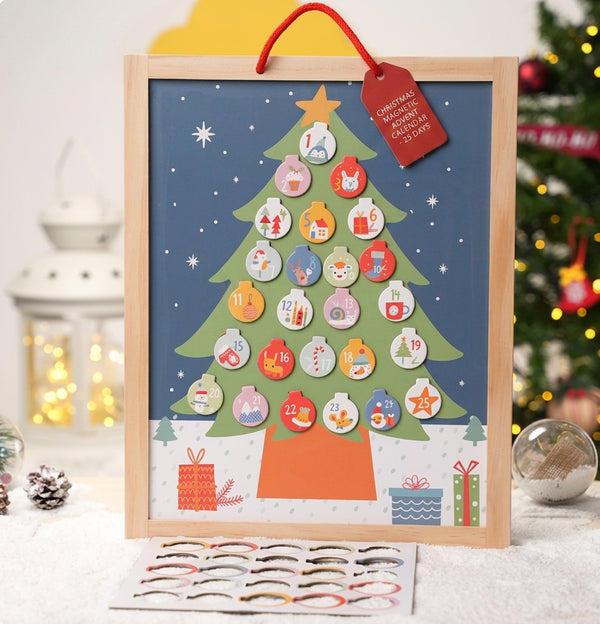
Once the tree stands, the nine ornaments and the string of lights transform the activity from construction to composition — and composition is a different cognitive operation from either building or decorating. Decoration is random: hang the red ball here, the star there, done. Composition is intentional: the star goes on top because it completes the shape. The lights spiral from the bottom because that creates even illumination. The ornaments cluster on the lower branches because those branches are wider and can hold more weight. Your child is not just placing objects — they are making spatial decisions about balance, symmetry, and visual hierarchy. And because every ornament attaches with Velcro and can be removed and repositioned without damage, your child will compose and recompose the tree dozens of times across the holiday season. Each recomposition is a new spatial hypothesis: what if the lights go vertically instead of spiraling? What if all the ornaments are on one side? What if the star is at the bottom instead of the top? Every hypothesis is tested immediately by the child's own eyes — no adult feedback required, no right answer imposed. This is the Montessori principle of self-correction made physical: the tree either looks balanced or it doesn't, and your child is the only judge.

Scientific 10-Piece Moderate Complexity Matches Preschoolers’ Developmental Level
The ten-piece assembly design is calibrated for a three-year-old's spatial working memory. Fewer than six pieces and the construction becomes trivial — no sequence planning needed, no structural dependencies to discover. More than fifteen and the assembly becomes frustrating — too many variables, too many points of failure, and a child who gives up before the tree stands. Ten pieces create a construction problem with enough steps to require genuine planning but few enough that the tree can be completed in a single focused session. Research on spatial development in preschool children shows that self-directed construction tasks with moderate complexity — tasks that require sequencing and structural reasoning but remain achievable without adult scaffolding — produce the strongest gains in mental rotation ability and spatial visualization skills (Lehman, Shelley, & Sorsby, 2019; Verdine et al., 2014). The tree does not need to be hard. It needs to be just hard enough that your child cannot build it by accident — they must build it on purpose.

Premium Felt Material Enables Pure Self-Judged Spatial Learning With Festive Glowing Magic
The felt material is not a cost choice — it is a cognitive choice. A wooden tree that snaps together with interlocking joints provides structural feedback through the connection mechanism itself: the pieces click when they are in the right position, and they do not click when they are not. This makes the assembly easier but it also makes it mechanical — your child is following the hardware's lead, not their own spatial reasoning. Felt provides no mechanical feedback. The pieces do not click, snap, or lock. They stand because your child positioned them to stand, and they fall because your child positioned them incorrectly. The material's simplicity strips away all external guidance and forces your child to rely entirely on their own spatial judgment — which means every success is theirs and every failure is information they can use. The tree stands because your child figured out how to make it stand. Not because the toy made it easy. Crafted from durable felt fabric with non-toxic coloring and nine Velcro-backed ornaments that survive hundreds of attach-detach-reattach cycles. The included light string adds the one element of magic that no construction toy can provide: the moment your child steps back, turns on the lights, and sees something they built with their own hands glowing in a dark room. Three AA batteries. No screens. No sounds. No instructions. Just ten pieces, a question, and a child who just proved that they can build something that stands.
Shop The Full Collection